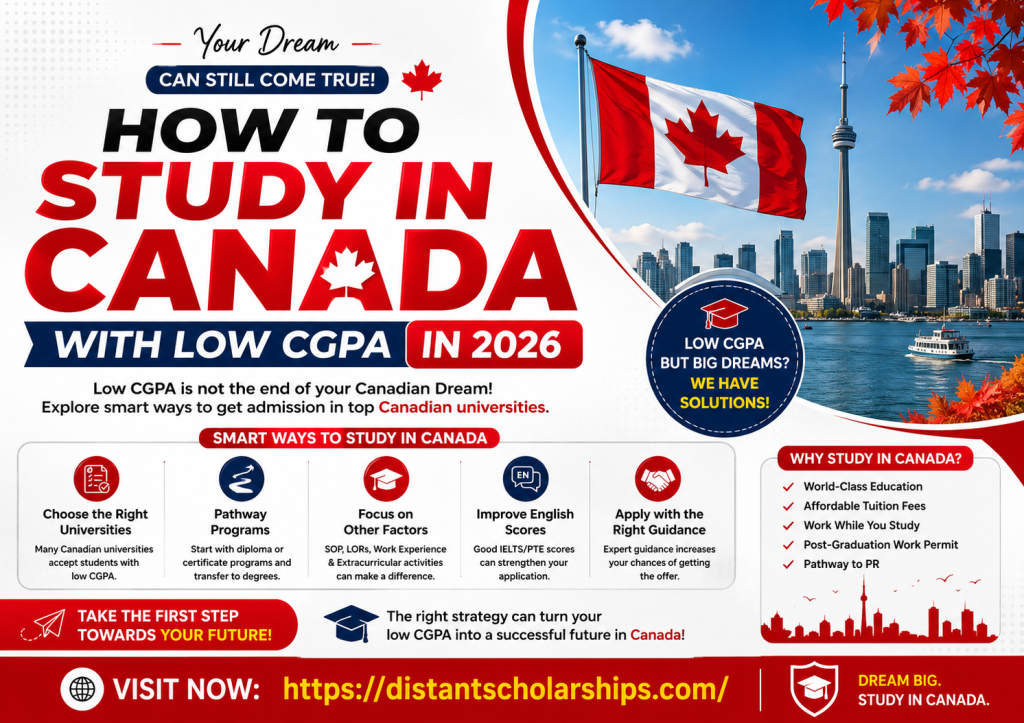

Worried that your low grades will stop you from studying in Canada? The good news is that there is a way to achieve your dream of studying in Canada with a low CGPA in 2026. Many students get admission every year with average or even low grades by creating a strong profile.
In this article, you’ll learn how to study in Canada with a low CGPA in 2026, including realistic options, strategies to improve your chances, and ways to avoid mistakes.
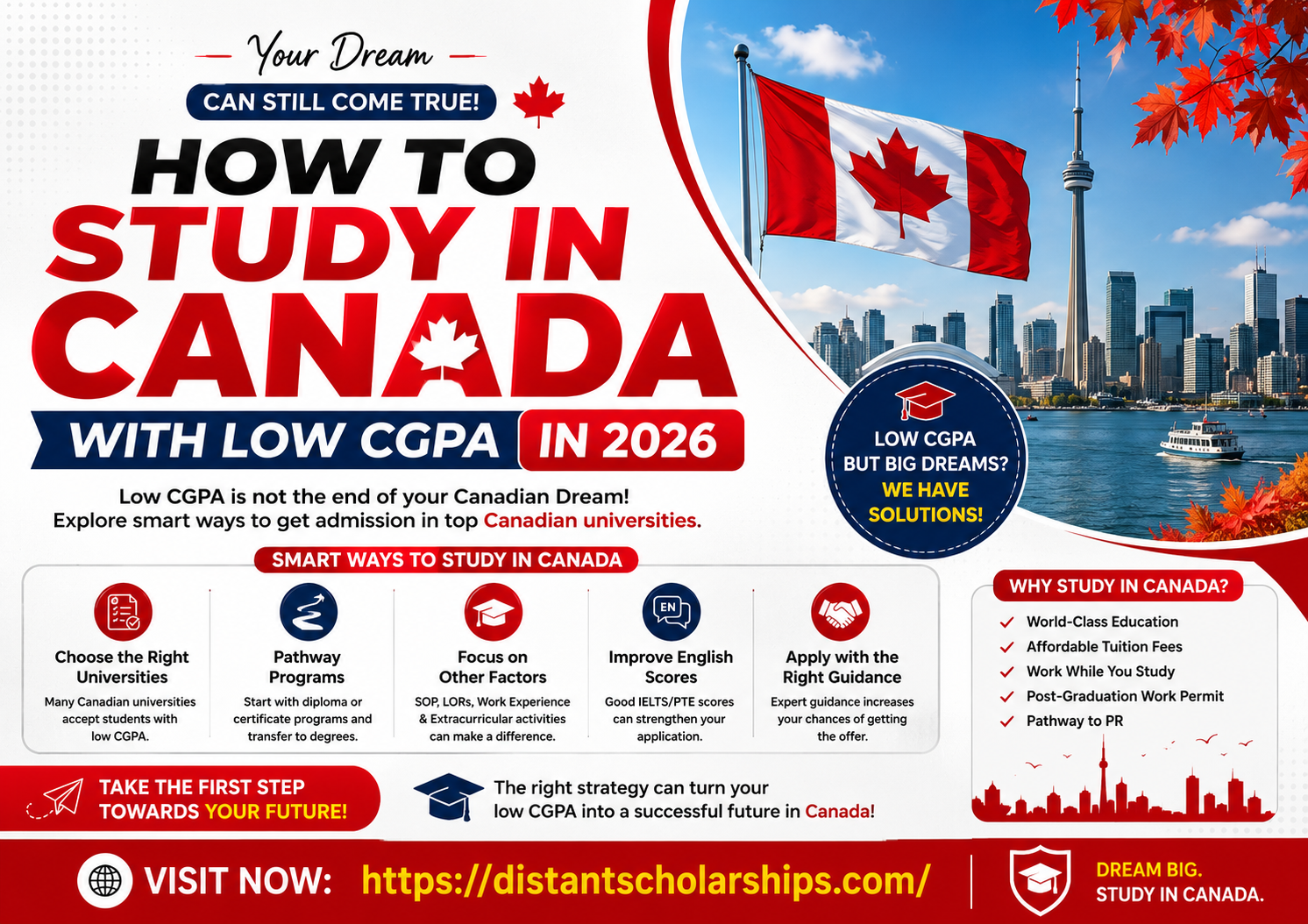
How to Study in Canada with Low CGPA in 2026 – Quick Overview
The host country is Canada, and candidates can study in Diploma, bachelor’s, and master’s programs. Candidates with a CGPA between 2 and 3 can easily gain admission. However, there are also alternative options, i.e., pathway programs, colleges and graduate diplomas. One of the key factors behind the success of an application is the overall profile of the candidate.
Also Read: How to Study in Canada Without IELTS
Is it possible to study in Canada with a low CGPA in 2026?
Absolutely yes, a low CGPA does not automatically disqualify you. There are many Canadian institutions which consider your overall profile, including experience, motivation, and skills and not just grades.
In fact, there are some universities which accept candidates with a 2.0–2.8 GPA, depending on the type of program.
Best Options for Candidates with Low CGPA
1) Apply in Colleges Instead of Universities
Canadian colleges usually:
- Have lower GPA requirements
- Offer diploma and certificate programs
- Provide a pathway to universities later
Easier entry + practical education.
Also Read: Fully Funded Harvard Radcliffe Fellowship 2027 USA
2) Go for Graduate Diploma Programs
If your CGPA is low for a Master’s:
Apply for:
- Graduate certificates or Postgraduate diplomas
The significant features of these programs are that they usually:
- Require a lower CGPA
- Can lead to a Master’s later
3) Look for Flexible Universities
Some universities:
- Accept lower CGPA
- Use a holistic admission process, i.e. SOP, experience, and Skills can compensate for low grades
What is considered a low CGPA?
Ever wondered what the categories of CGPA are? How can one say what a low CGPA is?
- Good CGPA: 3.0+
- Average: 2.7–3.0
- Low CGPA: Below 2.7
There are many programs which still accept students in this range, depending on the profile.
How to Secure Admission with Low CGPA?
Write a Strong SOP (Statement of Purpose)
This is a critical part of securing admission in Canada in 2026. Since you cannot improve your CGPA, you can improve your statement of purpose. A good statement of purpose must;
- Explain your academic journey
- Show improvement
- Highlight your goals
This can compensate for low grades.
Also Read: Fully Funded OIST Internship in Japan for Spring 2027
Improve Your Profile
Your main goal should be to improve your profile by adding;
- Internships
- Work experience
- Certifications
Canadian Universities value overall profile strength.
Score High in IELTS / TOEFL
You need to have strong English scores so that you may have higher chances of getting admission. Normally, IELTS ~6.5+ is ideal in your case.
Go to the Right Program
Avoid:
- Highly competitive programs
Choose:
- Practical or applied programs
- Colleges or pathway routes
Show Academic Improvement
If your last semesters are strong:
- Highlight them
- Mention the improvement trend
Common Mistakes to Avoid
There are some mistakes that most students make when applying to top universities. It may lead to rejection because competition is high in top universities. Secondly, most students ignore the importance and submit weak documents. Thirdly, one should actively look for program requirements before applying to it. It is your strategy that matters the most and not your CGPA.
Also Read: Fully Funded OYW AstraZeneca Scholarship 2026 South Africa
Who Should Consider This Path?
This guide is ideal for:
- Students with lower GPA (2.0–2.8)
- Applicants rejected previously
- Students switching fields
- Those targeting Canada as a study destination
When to Apply?
Canada has multiple intakes:
- Fall (September)
- Winter (January)
- Summer (May)
One should apply 6–8 months before the intake.
Application Process
- Choose program
- Prepare documents
- Submit application
- Receive the offer letter
- Apply for a visa
Pro Tip (VERY IMPORTANT)
Don’t apply unthinkingly; choose programs where your profile actually fits. This increases your chances significantly.