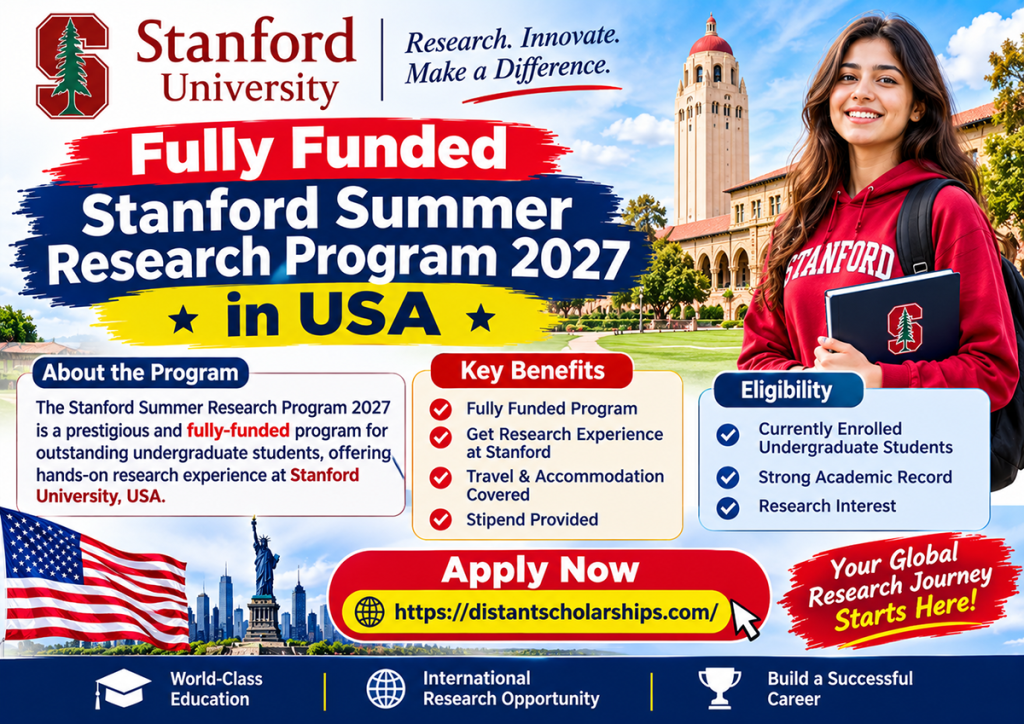

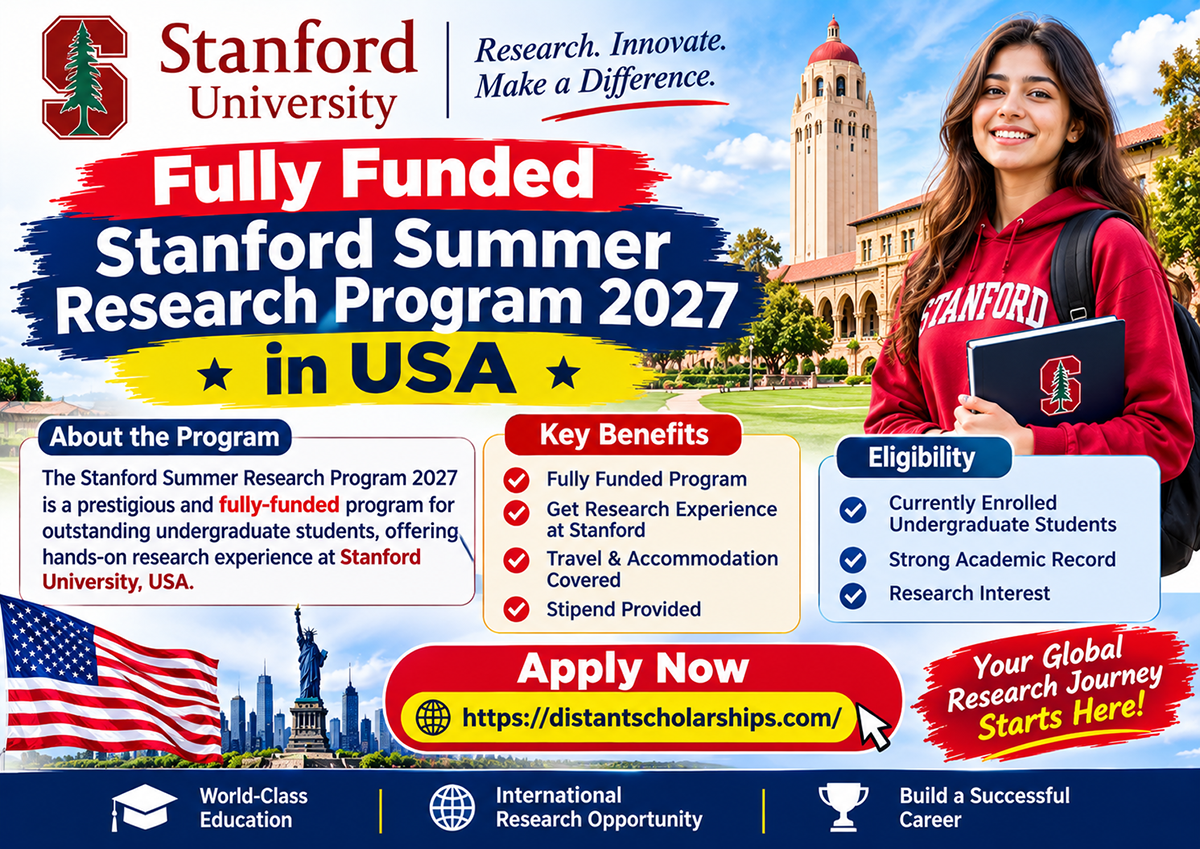
The Stanford Summer Research Program 2027 in the United States offers students an exciting opportunity to experience world-class research, work with experienced researchers, build academic skills, and explore future opportunities in higher education. Stanford University is internationally recognised for its academic excellence, innovative research, and contributions to science, technology, medicine, engineering, and other disciplines.
For students who dream of studying at a prestigious American university, a summer research opportunity at Stanford can be an important step toward achieving their academic goals.
However, applicants should understand that Stanford offers several different summer research opportunities. People sometimes use the name Stanford Summer Research Program informally to describe these opportunities, rather than a single scholarship open to all international students.
Stanford Summer Research Program 2027 – Overview
The Stanford Summer Research Program (SSRP), particularly the SSRP-Amgen Scholars Program, is an eight-week, full-time research experience organised by Stanford University’s Biosciences community.
The program is designed primarily for undergraduate students who want to pursue advanced research and eventually enter PhD programs in biomedical sciences and related disciplines.
Selected students are placed in research laboratories and work under the supervision of Stanford faculty members and laboratory mentors. They gain practical experience with research methods, scientific equipment, data analysis, and academic communication.
Important details at a glance;
| Category | Details |
|---|---|
| Program | Stanford Summer Research Program (SSRP-Amgen Scholars) |
| Host institution | Stanford University |
| Location | Stanford, California, USA |
| Program year | Summer 2027 |
| Duration | 8 weeks |
| Program dates | June 19 – August 14, 2027 |
| Funding | Fully funded |
| Research areas | Biomedical and biological sciences |
| Study level | Undergraduate |
| Application opening | November 1, 2026 |
| Application deadline | February 1, 2027 |
| Notification | Mid-March to April 2027 |
| Official website | Stanford Biosciences |
Stanford publishes these dates and benefits on its official SSRP pages. Applicants should check the website for updates.
What Is the Stanford Summer Research Program?
The Stanford Summer Research Program is an intensive academic and research opportunity that brings talented undergraduate students to Stanford for an immersive summer research experience.
Instead of attending ordinary classroom lectures, participants spend most of their time working in research laboratories. They collaborate with faculty members, graduate students, postdoctoral researchers, and other scientific professionals.
The main objective is to introduce students to the research environment of a leading American university and prepare them for advanced graduate education.
Students are encouraged to develop independent thinking, solve scientific problems, understand research methodologies, and communicate their findings effectively.
The program is particularly useful for students who are considering careers in:
- Biomedical sciences
- Molecular biology
- Genetics and genomics
- Biochemistry
- Cell biology
- Immunology
- Neuroscience
- Related scientific disciplines
During the eight-week experience, students become familiar with the academic expectations of graduate-level research.
They also have opportunities to build professional relationships with Stanford researchers and other students who share similar academic interests.
Stanford Summer Research Program – History
Stanford University has a long tradition of promoting undergraduate research, scientific discovery, and academic collaboration.
The Stanford Summer Research Program in Biomedical Sciences was developed to introduce talented undergraduate students to advanced research and prepare them for doctoral education.
Its purpose has been to make high-quality research experience accessible to students who might otherwise have limited opportunities to work in leading scientific laboratories.
The program has evolved through Stanford’s wider graduate education and biomedical research initiatives.
Historical development
The SIMR (Stanford Institutes of Medicine Summer Research Program), which is a separate high school research initiative, has a documented history beginning in 1998. It was initially established as the CCIS Summer Research Program.
In 2008, the program adopted the name Stanford Institutes of Medicine Summer Research Program after expanding to include additional research institutes. Additional research areas, including genetics, bioengineering, and bioinformatics, joined in subsequent years.
The undergraduate SSRP-Amgen program is a distinct initiative and should not be confused with SIMR. Stanford describes SSRP as an umbrella program supporting visiting undergraduate researchers through different funding sources, including Amgen Scholars and Stanford Medicine funding.
Why does this history matter?
The development of Stanford’s summer research initiatives demonstrates the university’s continuing commitment to research education.
Students participating in these opportunities can benefit from an established research environment, access to experienced mentors, and exposure to scientific work at an internationally recognised institution.
However, it is important to distinguish the history of the broader Stanford research initiatives from the founding date of the specific SSRP-Amgen funding arrangement.
Fully Funded Stanford Summer Research Program 2027 – Financial Benefits
One of the most attractive features of the SSRP-Amgen Scholars Program is its financial support.
Studying and living in California can be expensive, particularly for students who travel from other states or countries. The program provides several forms of financial assistance to help selected participants concentrate on their research.
According to Stanford’s published program information, the benefits include the following.
1. $4,800 stipend
Selected SSRP-Amgen scholars receive a $4,800 stipend for their summer research experience. This financial support helps participants cover personal expenses during the program.
2. Free summer accommodation
The program provides summer housing for participating scholars. This is particularly valuable because accommodation in the Stanford and Palo Alto area can be expensive.
3. Meals and flex card
Participants receive meal support and a flex card as part of the program’s financial package. This helps reduce daily living costs during the research period.
4. Travel expenses
Travel to and from Stanford is included in the published funding package. This is an important benefit for eligible students who need to travel to California to participate.
5. Research laboratory experience
Students receive access to Stanford research laboratories and work on research projects under the supervision of faculty members and laboratory mentors.
6. Professional development
Participants can attend professional development workshops, faculty lectures, and journal clubs. These activities help students develop the skills needed for graduate education.
7. Graduate school preparation
The program guides students in applying to PhD programs, preparing academic CVs, writing graduate school personal statements, and improving presentation skills.
8. Networking opportunities
Participants interact with Stanford faculty, graduate students, postdoctoral researchers, and fellow summer scholars. These connections can help students better understand research careers and graduate education.
9. Final research symposium
At the end of the program, students present their research findings through individual presentations and posters. This gives them a chance to show what they have learned and receive feedback from the academic community.
Funding clarification: These benefits describe the SSRP-Amgen package. Stanford’s broader SSRP umbrella can assign different funding sources, so applicants should check their actual funding offer rather than assume every admitted participant receives an identical package.
Stanford Summer Research Program 2027 – Eligibility Criteria
Before applying, students should review the eligibility requirements carefully. Stanford has specific academic, enrollment, citizenship, and career-interest requirements for its SSRP-Amgen funding pathway.
The program is not a general summer internship open to every student worldwide.
Stanford’s published eligibility criteria require applicants to meet the following conditions.
1. Undergraduate student status
Applicants must be currently enrolled undergraduate students at an accredited four-year college or university in the United States, Puerto Rico, or another U.S. territory.
2. Academic year
Applicants must belong to one of the following categories:
- Undergraduate sophomores.
- Undergraduate juniors.
- Non-graduating seniors who will return to undergraduate studies in the fall after the summer program.
Students who have already completed their undergraduate degrees are not eligible.
3. Citizenship requirements
For the SSRP-Amgen Scholars funding pathway, applicants must be:
- United States citizens; or
- United States permanent residents.
International students who do not meet these citizenship requirements are not eligible for this particular funding pathway.
4. Minimum GPA
Applicants must have a cumulative GPA of at least 3.2 on a 4.0 scale. Students should provide accurate academic records and ensure their transcripts reflect their most recent completed academic term.
5. Research interests
The program is primarily intended for students interested in pursuing a PhD in biomedical sciences or related research fields. Students interested in MD/PhD programs may also be considered in exceptional cases.
6. Commitment to research
Successful applicants should demonstrate genuine interest in scientific research and the motivation to participate in an intensive, full-time laboratory experience. Stanford’s official eligibility page provides the detailed criteria for the SSRP funding pathways.
Can International Students Apply?
This is one of the most important questions for students from Pakistan, India, Bangladesh, Nigeria, Nepal, and other countries. Although Stanford is a globally recognised university, not every Stanford summer research opportunity accepts international applicants.
For the 2027 SSRP-Amgen Scholars Program, the published eligibility requirements specify U.S. citizenship or permanent residency, along with enrollment as an undergraduate at an eligible U.S. institution.
Therefore, international students studying outside the United States should not assume that they can apply for this particular fully funded opportunity.
What about students studying in the United States on an F-1 visa?
An international undergraduate student studying at a U.S. university on an F-1 visa does not automatically meet the citizenship requirement for SSRP-Amgen.
Applicants should review the official criteria rather than assume that studying at an American university makes them eligible.
What about the Stanford SIMR program?
Stanford also offers the Stanford Institutes of Medicine Summer Research Program (SIMR), which is designed for high school students.
However, SIMR has its own restrictions. Its published 2027 eligibility requirements state that applicants must:
- Be high school juniors or seniors.
- Be at least 16 years old by the start of the program.
- Live in and attend high school in the United States.
- Be U.S. citizens or residents with a green card.
SIMR also strongly favours students from the San Francisco Bay Area.
Important: Neither SSRP-Amgen nor SIMR should be advertised as universally available fully funded scholarships for international students. Applicants should check other Stanford research opportunities if they do not meet these eligibility requirements.
Stanford Summer Research Program 2027 – Research Fields and Available Opportunities
Stanford has an extensive research environment covering several scientific disciplines. The SSRP experience focuses on biomedical and biological sciences, allowing participants to explore research questions under the guidance of experienced faculty and laboratory mentors.
Some of the relevant research areas include:
1. Molecular Biology
Molecular biology examines biological processes at the molecular level. Students may work with DNA, RNA, proteins, gene expression, and cellular functions.
2. Genetics and Genomics
Genetics and genomics research focuses on genes, inherited characteristics, genetic disorders, and the structure and function of genomes.
3. Immunology
Immunology examines the body’s immune system and how it responds to infections, diseases, and other biological challenges.
4. Neuroscience
Neuroscience investigates the nervous system, brain function, neurological disorders, and the biological mechanisms responsible for human behaviour and cognition.
5. Cell Biology
Cell biology studies the structure, behaviour, and functions of cells. Research may involve cellular communication, cell development, and disease mechanisms.
6. Biochemistry
Biochemistry explores the chemical processes that occur in living organisms, including protein interactions, metabolic pathways, and enzyme activity.
7. Biomedical Research
Biomedical research aims to improve understanding of human diseases and support the development of new medical treatments and technologies.
The actual research project assigned to each student depends on faculty availability, laboratory capacity, and the alignment between the student’s interests and available projects.
Applicants should remember that admission to SSRP does not guarantee placement in a particular laboratory.
Stanford Summer Research Program 2027 – Required Documents
Applicants should prepare their application documents before starting the online application process. A complete application is important because missing documents may prevent the application from being considered.
According to Stanford’s published SSRP application requirements, you must submit the following documents.
1. Academic transcripts
Applicants must provide unofficial college transcripts. The transcripts should demonstrate the applicant’s academic performance and current undergraduate enrollment. Students should ensure that the documents are clear and readable.
2. Resume or Curriculum Vitae
A resume or CV should provide information about the applicant’s academic background, research experience, achievements, and relevant skills.
A strong CV may include:
- Full educational history.
- Academic achievements.
- Research experience.
- Laboratory skills.
- Scientific projects.
- Relevant internships.
- Publications, if any.
- Awards and honours.
- Technical skills.
- Volunteer experience.
Students without previous research experience can still present relevant academic projects, laboratory coursework, and scientific interests.
3. Two letters of recommendation
Applicants must submit two letters of recommendation. Ideally, these should come from professors, academic supervisors, or instructors who can assess the student’s academic abilities and research potential.
A good recommendation letter should discuss the student’s:
- Academic performance.
- Critical thinking.
- Research potential.
- Problem-solving abilities.
- Work ethic.
- Motivation to pursue advanced education.
Students should contact their recommenders early, so they have sufficient time to prepare and submit the letters.
4. Essay responses
Applicants must complete essay questions as part of the online application. These responses allow the selection committee to understand the applicant’s academic interests, research goals, and motivation. Students should explain why they are interested in research, what scientific subjects they want to explore, and how the experience fits into their long-term academic plans. Submit all application materials, including recommendation letters, by the stated deadline.
Stanford Summer Research Program 2027 – How to Apply
The application process is conducted online through Stanford’s official application system.
Interested students should follow the steps below.
Step 1: Visit the official Stanford website
First, visit the Stanford Biosciences website and open the Stanford Summer Research Program section.
Official program page: Stanford Summer Research Program – Official Website
Carefully read the program description, eligibility requirements, financial benefits, and application instructions.
Step 2: Check your eligibility
Before you begin the application, make sure you meet all eligibility requirements. Check your:
- Citizenship or permanent residency status.
- Undergraduate enrollment.
- Academic year.
- Cumulative GPA.
- Research and career interests.
Students who do not meet the requirements should avoid submitting applications under an ineligible funding category.
Step 3: Prepare your application documents
Prepare your academic transcripts, CV, essay responses, and two recommendation letters. It is advisable to prepare these documents well before the deadline.
Step 4: Complete the online application
Visit the official page and simply follow the instructions to access the application portal.
Stanford SSRP 2027 Application Portal and Instructions
Complete the requested personal, educational, and academic information.
Step 5: Select your research interests
Applicants are asked to identify their preferred research areas. Carefully consider the scientific subjects that match your academic background and future goals. Stanford uses this information to help coordinate research laboratory placements.
Step 6: Upload your documents
Upload all documents in the specified formats.
These include:
- Essay responses.
- Two recommendation letters.
- Unofficial college transcripts.
- Resume or CV.
Make sure the admissions office receives all required materials by the application deadline.
Step 7: Review and submit your application
Before submitting, review your application carefully. Check your personal information, academic details, essays, and uploaded documents. Also confirm that you submitted both recommendation letters successfully.
Step 8: Wait for admission decisions
Stanford plans to distribute admission notifications between mid-March and April 2027. Successful applicants will receive further information about admission and laboratory placement. Applicants should check their email and the official application portal for updates.
Stanford Summer Research Program 2027 – Deadline
The published 2027 application schedule for the SSRP-Amgen Scholars Program is as follows:
| Application activity | Date |
|---|---|
| Application opens | November 1, 2026 |
| Application deadline | February 1, 2027 |
| Deadline time | 11:59 PM Pacific Time |
| Admission notifications | Mid-March to April 2027 |
| Program begins | June 19, 2027 |
| Program ends | August 14, 2027 |
| Final application deadline | February 1, 2027, at 11:59 PM Pacific Time. |
Applicants must not wait until the last day to submit their applications because they must also receive recommendation letters and other supporting documents before the deadline.
Stanford lists these dates on its official application page.
Selection Process: How Are Students Selected?
Admission to Stanford’s Summer Research Program is competitive. The university looks for students who demonstrate strong academic preparation, genuine research interests, and the potential to benefit from an intensive research experience.
The selection process generally considers several aspects of an applicant’s background.
Academic performance
A strong academic record is important. Applicants must meet the required GPA and demonstrate an understanding of their chosen scientific disciplines.
Research motivation
Students should clearly explain why they want to participate in the program and what they hope to learn. Applicants with a genuine interest in pursuing research careers should communicate their goals effectively.
Recommendation letters
Strong recommendation letters can help demonstrate an applicant’s academic abilities, personal qualities, and potential to succeed in a research environment.
Quality of essays
The application essays are an opportunity to explain your academic journey, scientific interests, and future ambitions. Avoid generic statements. Provide specific examples of academic projects, research interests, or scientific questions that motivate you.
Research experience
Previous research experience can strengthen an application, although students should present their existing academic and laboratory experience honestly.
The university also considers the availability of appropriate research mentors and laboratory projects.
What Happens After Selection?
Students who are selected and receive an admission offer will receive additional information about the next steps. The process generally involves the following activities:
- Admission confirmation: Selected students receive an official admission notification and instructions for accepting their place.
- Funding confirmation: Students are informed about their funding arrangements.
- Laboratory placement: Stanford coordinates research placements based on student interests, available laboratories, and faculty mentor availability.
- Program preparation: Participants receive instructions concerning program dates, accommodation, travel, and other arrangements.
- Arrival at Stanford: Students travel to Stanford and begin their summer research experience.
- Research activities: Participants work with faculty members and laboratory mentors throughout the eight-week program.
- Final symposium: Students present their research findings through presentations and posters.
Applicants should follow the instructions included in their official admission correspondence.
Stanford Summer Research Program 2027 – Important Tips
Getting into a prestigious research program requires preparation. Students should not wait until the application deadline to start collecting documents or writing essays.
Here are some useful tips for prospective applicants.
Maintain a strong GPA
Academic performance is an important part of the application. Students should aim to maintain a GPA comfortably above the minimum requirement of 3.2.
Develop research skills
Participate in university research projects, laboratory activities, scientific competitions, and relevant academic projects. These experiences can help demonstrate your interest in scientific discovery.
Write a convincing personal statement
Your essays should explain:
- Why do you want to participate in the Stanford Summer Research Program 2027?
- Which research subjects interest you most?
- What scientific problems would you like to explore?
- How will this experience support your future education?
- Why are you interested in pursuing a PhD?
Use real examples from your academic experience.
Choose recommenders carefully
Ask professors who know your academic abilities and can provide meaningful examples of your potential. Do not wait until the final week to contact them.
Prepare a professional CV
Your CV should be organised, accurate, and easy to read. Highlight relevant academic achievements, research activities, laboratory skills, and scientific projects.
Research Stanford’s laboratories
Explore Stanford’s faculty research areas and identify subjects that match your academic interests. Although admission does not guarantee a particular laboratory placement, understanding the research environment can help you write more focused essays.
Submit early
Submit your application well before February 1, 2027. This provides time to identify missing documents and confirm that your recommenders have completed their submissions.
Stanford SIMR 2027: An Alternative Summer Research Opportunity
Students searching for Stanford summer research opportunities may also encounter the Stanford Institutes of Medicine Summer Research Program (SIMR). Although SIMR and SSRP-Amgen are different programs, both provide opportunities to experience scientific research at Stanford. SIMR is specifically designed for high school students interested in biomedical research.
SIMR 2027 important details
| Category | Details |
|---|---|
| Program | Stanford Institutes of Medicine Summer Research Program |
| University | Stanford University |
| Location | California, USA |
| Duration | 8 weeks |
| Tentative dates | June 7 – July 29, 2027 |
| Application opening | December 18, 2026 |
| Application deadline | Late February 2027 |
| Academic level | High school juniors and seniors |
| Minimum age | 16 years |
| Participation cost | No participation cost for selected students |
| Stipend | Limited need-based stipends |
| Housing | Not provided |
| Transportation | Not provided |
The program offers research opportunities in several areas, including:
- Immunology.
- Neurobiology.
- Cancer biology.
- Bioengineering.
- Stem cell and regenerative medicine.
- Cardiovascular biology.
- Bioinformatics.
- Genetics and genomics.
Students can also explore a bioengineering bootcamp option.
SIMR funding
Unlike the SSRP-Amgen program, SIMR does not generally provide a stipend to every participant. Selected students participate without paying a program participation fee, but a limited number of need-based stipends are available.
Check the official application instructions for the 2027 cycle application fee. The previous application cycle charged $50 and offered fee waivers for eligible applicants.
Housing and transportation are not provided, and participants must arrange to live with an appropriate family member or legal guardian.
SIMR 2027 Eligibility
Applicants must:
- Be high school juniors or seniors as of fall 2026.
- Be graduating in 2027 or 2028.
- Be at least 16 years old by the program start date.
- Currently live in and attend high school in the United States.
- Be a United States resident or green card holder.
The selection process strongly favours students from the Bay Area.
Official SIMR website
Stanford Institutes of Medicine Summer Research Program
The university has indicated that its 2027 application information will become available on December 18, 2026. The tentative program dates are June 7 to July 29, 2027.
15. Frequently Asked Questions (FAQs)
Q1. Is the Stanford Summer Research Program 2027 fully funded?
Yes. The SSRP-Amgen Scholars Program offers a fully funded research experience. Its published benefits include a $4,800 stipend, summer housing, meals, travel to and from Stanford, and a flex card.
Funding arrangements may differ for students admitted through other SSRP funding pathways.
Q2. What is the duration of the Stanford Summer Research Program?
The SSRP-Amgen Scholars Program lasts eight weeks. The 2027 program is scheduled to run from June 19 to August 14, 2027.
Q3. What is the last date to apply?
The application deadline is February 1, 2027, at 11:59 PM Pacific Time. Applicants must also submit their recommendation letters and other required documents before the deadline.
Q4. Can Pakistani students apply?
Pakistani students studying outside the United States are not eligible for the SSRP-Amgen Scholars funding pathway under its published U.S. citizenship or permanent residency requirements. Students studying at American universities on an F-1 visa also do not automatically qualify.
Q5. Is IELTS required?
The published SSRP application requirements do not list IELTS or TOEFL as mandatory application documents. Applicants should follow the current application instructions and any additional requirements communicated by Stanford.
Q6. Is a minimum GPA required?
Yes. SSRP-Amgen applicants must have a cumulative GPA of at least 3.2 on a 4.0 scale.
Q7. Can master’s students apply?
The published eligibility criteria are intended for undergraduate students enrolled in eligible four-year institutions. Students who have already completed their undergraduate degrees are not eligible.
Q8. Are recommendation letters required?
Yes. Applicants must submit two letters of recommendation.
Q9. Do students receive a certificate?
Participants complete a structured research experience and present their work at the concluding research symposium. Students should consult Stanford’s program documentation for the exact completion documentation provided.
Q10. Is accommodation provided?
Yes. Summer housing is included in the published SSRP-Amgen funding package.
Q11. Do applicants need previous research experience?
Previous research experience can strengthen an application, but Stanford’s published eligibility requirements do not require it. Applicants should demonstrate their academic preparation, scientific interests, and motivation.
Q12. Does admission guarantee a place in a particular research laboratory?
No. Stanford coordinates laboratory placements for admitted scholars. Placements depend on mentor availability and alignment with research projects.
Q13. When will successful applicants receive admission decisions?
Admission notifications are expected between mid-March and April 2027.
Q14. Is there an application fee?
Applicants should consult the official SSRP application portal for any applicable application charges and instructions. The published SSRP application requirements do not establish a universal fee for all funding pathways.
16. Official Websites and Important Application Links
Students should always use Stanford’s official websites to obtain accurate information and submit applications. Here are the most important resources for the 2027 program.
Stanford Biosciences
Official SSRP-Amgen program information, research opportunities, and funding details.
Visit the official program website.
SSRP 2027 Application
Application instructions, important dates, and online application access.
Eligibility and Requirements
Detailed academic, citizenship, and document requirements.
Stanford SIMR
Information about the separate high school summer research program.
Visit the SIMR official website.
Final Thoughts
The Fully Funded Stanford Summer Research Program 2027 represents an excellent opportunity for eligible undergraduate students who want to develop their scientific knowledge, gain practical laboratory experience, and prepare for advanced research careers.
Through the SSRP-Amgen Scholars Program, selected participants can spend eight weeks at Stanford University, collaborate with experienced researchers, participate in professional development activities, and present their findings at a final research symposium.
The financial support, including a $4,800 stipend, summer accommodation, meals, and travel assistance, makes the opportunity particularly attractive.
However, students must review the eligibility requirements carefully. The SSRP-Amgen funding pathway is restricted to U.S. citizens and permanent residents enrolled at eligible American institutions. It is not a general international scholarship.
Students who meet the requirements should begin preparing their applications early. With the application deadline set for February 1st, 2027, applicants have time to organise their academic transcripts, recommendation letters, CVs, and essays before submitting.
The most important advice is to rely on Stanford’s official website for the latest information, eligibility conditions, funding details, and application instructions. A well-prepared application and a genuine commitment to scientific research can help students make the most of this prestigious academic opportunity.